Learn
Peptides, explained without the hype
What peptides are, how they signal your cells, powder versus liquid, when a consult is required, and how to tell a real pharmacy product from a grey-market vial. Education only — not medical advice.
Section 1
What are peptides?
A peptide is a short chain of amino acids. Amino acids are the building blocks your body uses to make almost everything, and when a handful of them are linked together in a specific order, you get a peptide. Link hundreds together and you get a protein instead. So the simplest way to think about it: peptides are small, proteins are big.
Your body already makes hundreds of peptides on its own, every single day. Insulin is a peptide. So is the gut hormone that tells your brain you are full after dinner. So are the signals that kick off tissue repair after a hard workout. None of this is exotic — it is the ordinary language your cells use to talk to each other.
That is really what a peptide is: a messenger. It does not push your whole system in one direction. It carries one instruction to the cells that are built to receive it. Think of a peptide as a key, and the cell as a door with a very particular lock. A key that fits opens that one door. A key that does not fit does nothing at all. That is why peptides are described as targeted, while something broader — like a steroid or a stimulant — is more like turning up the volume on the entire house.
Because they are smaller and more specific than proteins, peptides can be designed or copied to match a signal the body already understands. A prescription peptide is not adding a foreign process to your biology. It is speaking a language your cells already know, usually to restore or amplify a signal that has gotten quieter with age, stress, injury or illness.
One important caveat before you go further: "peptide" describes a shape, not a guarantee. Some peptides are well studied and widely prescribed. Others are early in the evidence. A licensed provider is the person who decides which — if any — is appropriate for you.

Amino acids
Individual building blocks
Peptide chain
Linked in a specific order
Receptor
The matching lock on a cell
Cell response
One specific instruction runs
Section 2
How do peptides actually work?
Every cell in your body is covered in receptors. A receptor is a docking point shaped to accept one kind of messenger and ignore everything else. When a peptide reaches a cell with a matching receptor, it binds — and that binding is the whole event. Nothing is forced into the cell. A switch is flipped on the outside, and the cell reacts on the inside.
What happens next depends entirely on which receptor was activated. Bind the receptor that governs appetite signalling, and the brain gets the message that you are satisfied sooner and stay satisfied longer. Bind a repair-related receptor near damaged tissue, and the cell ramps up the local repair work it already knows how to do. Bind a receptor in the pituitary, and the gland releases a pulse of the growth hormone your body was already scheduled to make.
That last example is the key idea. Most peptide therapy is not about installing a new function. It is about amplifying or restoring a signal you already produce. The machinery is yours; the peptide is the message telling it to run. That is also why effects tend to be targeted instead of system-wide — a message only lands where a matching receptor exists.
Targeted does not mean risk-free. Signals interact. Amplifying one pathway can affect blood sugar, digestion, fluid balance, mood or sleep, which is exactly why a licensed provider reviews your history and current medications before anything is prescribed.
Finally, the practical part people always ask about: why the injection? Peptides are chains of amino acids, and your stomach exists to break chains of amino acids apart. Swallow most peptides and stomach acid and digestive enzymes destroy them before they ever reach the bloodstream. A small subcutaneous injection into the fat just under the skin skips that problem entirely and delivers the message intact.
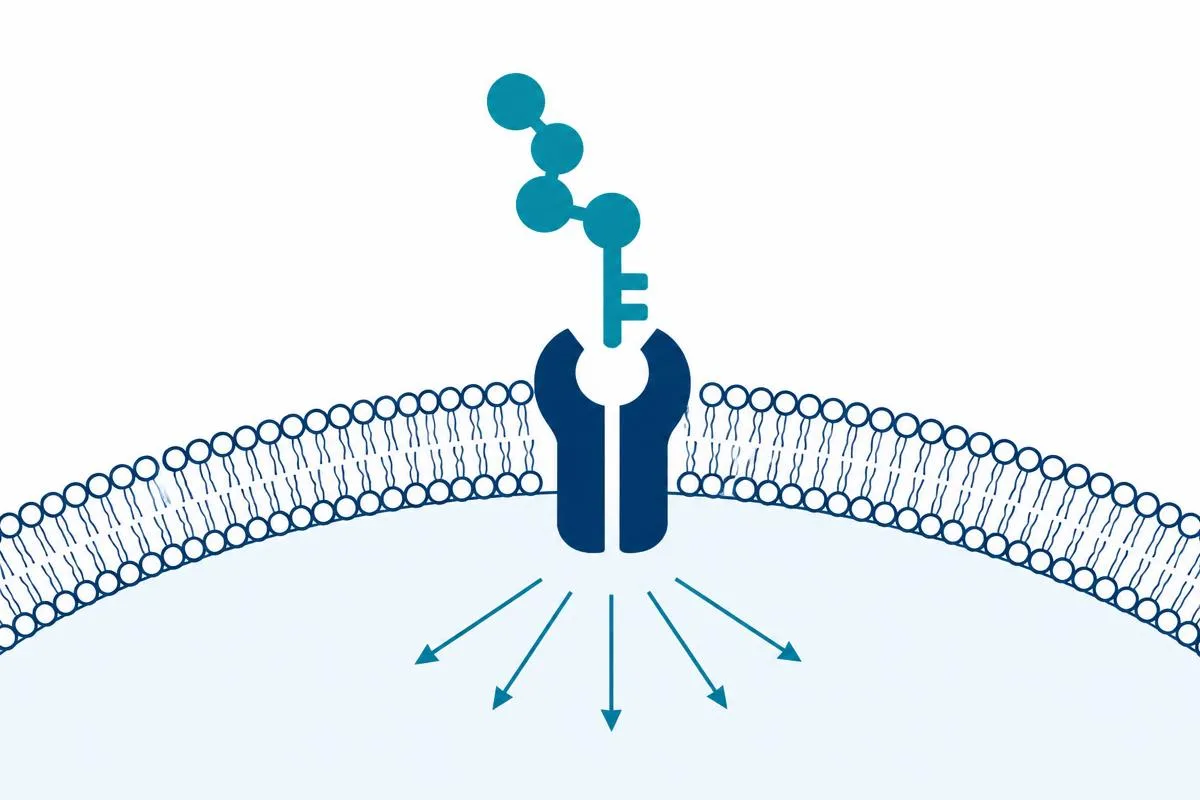
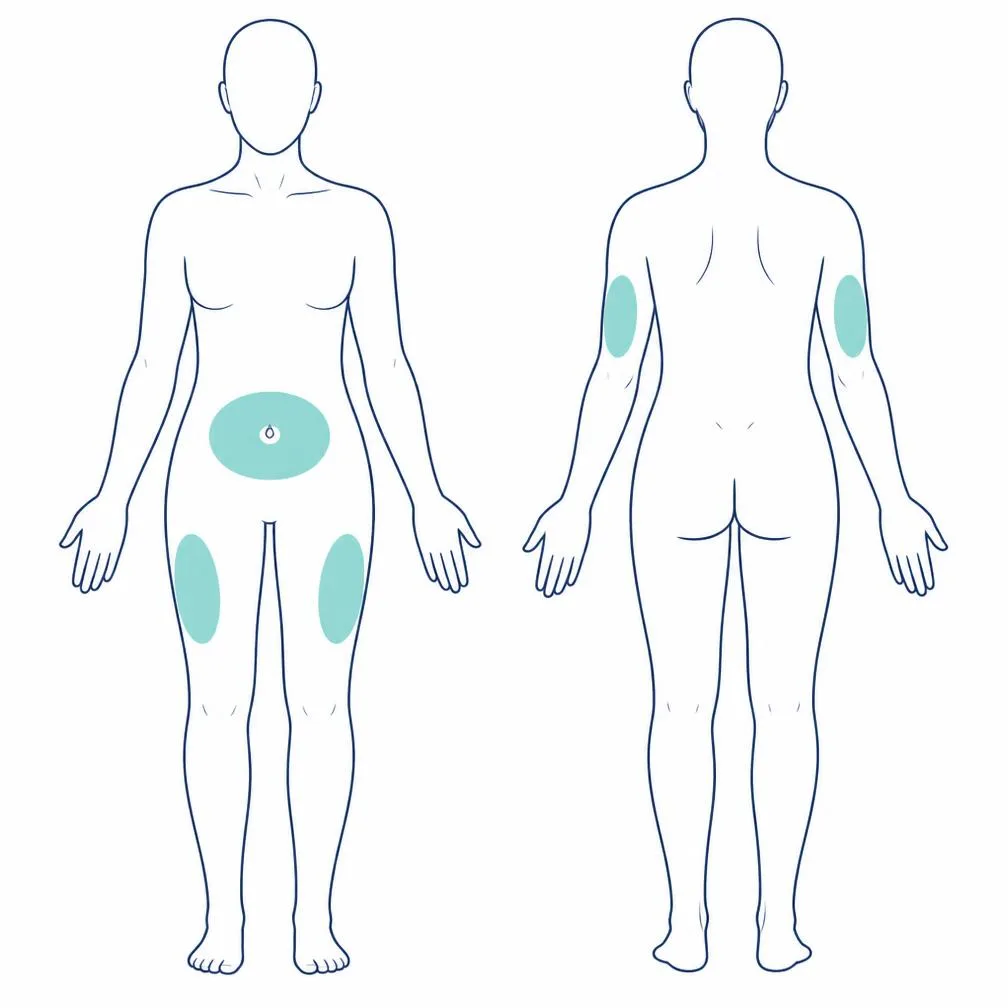
1. Signal
The peptide travels to the tissue that can read it.
2. Receptor
It binds the one receptor shaped to accept it.
3. Cell response
The cell carries out that single instruction.
Section 3
Which peptide is right for me?
Three quick questions. This is a starting point for your reading — not a medical quiz, and not a diagnosis.
Question 1 of 3
Section 4
Powder vs liquid — which do I need?
The difference is simply whether the pharmacy removed the water before shipping. Powdered peptides are lyophilized — freeze-dried into a small, stable cake at the bottom of the vial. You add bacteriostatic water yourself before the first use, let it dissolve, and store it in the fridge from then on. Liquid peptides arrive already mixed, so there is nothing to prepare.
Powder is the more forgiving option. Dry peptide is far more stable, so it travels and stores better, and most powder items do not require a scheduled consult before ordering. Liquid is the more convenient option: open, draw, inject. The trade-off is that a pre-mixed peptide is fragile, so it usually requires cold shipping and a consult on most items.
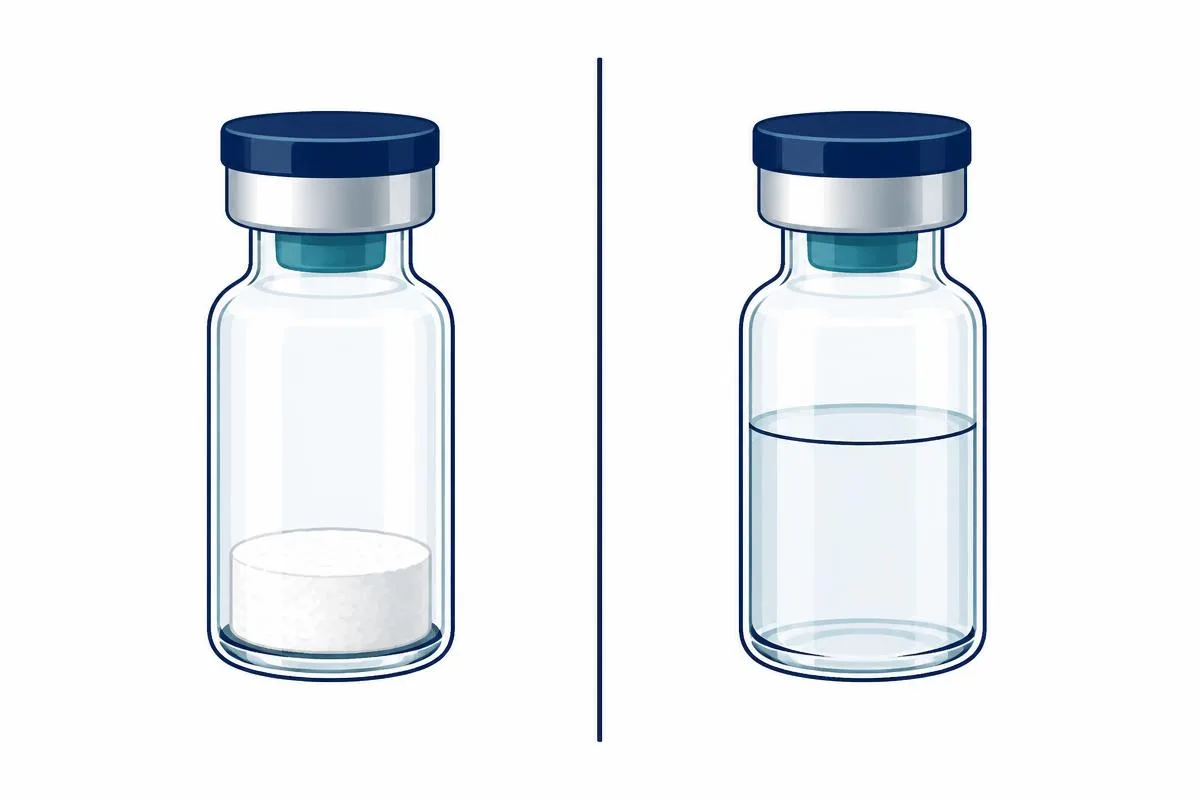
| Powder (lyophilized) | Pre-mixed liquid | |
|---|---|---|
| Arrives as | A dry cake in a sealed vial | Ready-to-use solution |
| Prep needed | Mix with bacteriostatic water once | None — draw and go |
| Shelf stability | Longer; more forgiving in transit | Shorter once mixed by the pharmacy |
| Shipping | Standard shipping in most cases | Cold-shipped where required |
| Consult | Most powder items: no scheduled consult | Consult required on most items |
| Best for | Value, storage and flexibility | Convenience and simplicity |
Section 5
Do I need a doctor's consult?
For most of the catalog, no separate consult is needed. Roughly half of all items — including most powdered peptides — ship without booking a video visit. A licensed provider still reviews and prescribes every order; you just don't need to schedule a call.
A consult IS required for:
- GLP-1 medications (semaglutide and tirzepatide)
- Most pre-mixed liquid preparations
Speak to a physician first if you:
- have a chronic condition or ongoing illness
- take prescription medication
- are pregnant or nursing
- have a history of cancer, thyroid disease, pancreatitis, or heart or kidney problems
If unsure, add a Doctor's Consult at checkout.
Section 6
How to know you're getting the real thing
Every medication we work with is compounded in a U.S. pharmacy that answers to a regulator. There are two kinds, and both matter.
503B outsourcing facilities are registered with and inspected by the FDA, and they follow current Good Manufacturing Practice (cGMP) — the same quality-system framework that governs commercial drug manufacturing, covering equipment, process controls, batch testing and records.
503A pharmacies are licensed by state boards of pharmacy and compound patient-specific prescriptions to USP <795> and <797> standards, which set the rules for non-sterile and sterile preparation, environment and testing.
Now the honest contrast. Grey-market vials sold online outside the pharmacy system sit outside all of that. There is no requirement that anyone test what is in the vial, no licensed pharmacy accountable for how it was made, and no prescriber reviewing whether it is appropriate for a person. A label that disclaims human use is not a quality tier — it is the seller saying they take no responsibility for what happens next. Everything on this site is a prescription medication, compounded in a licensed U.S. pharmacy and third-party tested.
| HealthProsUSA | Unlicensed grey-market sellers | |
|---|---|---|
| Testing | Third-party tested for potency, sterility and contaminants | No testing requirement; certificates are self-supplied or absent |
| Pharmacy licensing | U.S. 503A pharmacies and FDA-registered 503B outsourcing facilities | Unlicensed suppliers; no pharmacy oversight |
| Prescription | Required — a licensed provider reviews and prescribes every order | None; sold to anyone with a card |
| Accountability | FDA inspection (503B) and state board of pharmacy oversight (503A) | No regulator, no recourse if something is wrong |
| Intended use | Prescription medication, dispensed to a named patient | Sold without a prescription and disclaimed as not intended for humans |
Compounded medications are not FDA-approved products.
See how we source and testSection 7
Glossary
- Peptide
- A short chain of amino acids — usually 2 to 50 — that carries a signal to cells.
- Amino acid
- The building block of peptides and proteins. Twenty of them make up nearly everything your body builds.
- Lyophilized
- Freeze-dried into a stable powder. Water is removed so the peptide keeps longer before it is mixed.
- Bacteriostatic water
- Sterile water containing a small amount of benzyl alcohol, used to reconstitute powdered peptides and stop bacterial growth in a multi-use vial.
- Subcutaneous
- Into the layer of fat just under the skin — the most common way peptides are injected, with a very short, fine needle.
- Half-life
- How long it takes for half of a dose to clear the body. It is one reason some items are taken daily and others weekly.
- Secretagogue
- A compound that prompts your body to release more of something it already makes — for example, its own growth hormone.
- GLP-1
- Glucagon-like peptide-1, a natural gut hormone that signals fullness and helps regulate blood sugar. Semaglutide and tirzepatide act on this pathway.
- Compounded medication
- A medication prepared by a licensed pharmacy for a specific patient or prescriber need. Compounded medications are not FDA-approved products.
- 503A
- A compounding pharmacy licensed by a state board of pharmacy, preparing patient-specific prescriptions to USP <795> and <797> standards.
- 503B
- An outsourcing facility registered with and inspected by the FDA that compounds larger batches under cGMP.
- cGMP
- Current Good Manufacturing Practice — the FDA's enforceable quality-system rules covering facilities, process controls, testing and records.
- Off-label
- Prescribing an approved medication for a use, group or route other than the one on its official label. It is legal, common, and a provider judgment call.
This page is education, not medical advice, and nothing here diagnoses or treats any condition. A licensed provider makes the final call on whether any medication is appropriate for you.
Ready to begin?
Start through the secure consultation workflow when the intake link becomes active.
Treatment is only available if determined medically appropriate by a licensed provider.